

+++
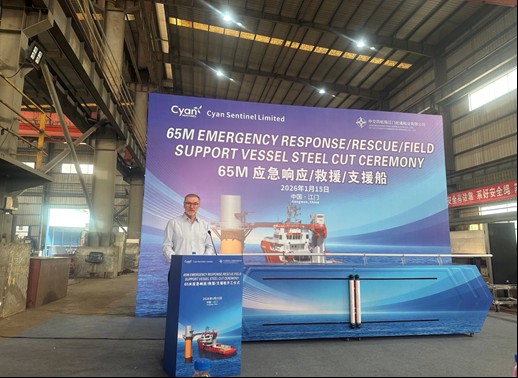
There’s something significant about a steel cutting ceremony; the first cut into steel that will, over the next couple of years, become a fully operational ERRV.
For us, it’s where everything begins.
We’ve now marked that moment for our next 65m Energy Support Vessel (ESV), with steel cut at Jiangmen Hangtong Shipbuilding in Guangdong Province, China. It was a proud milestone to see the project move from plan to reality, with our CEO Rory Deans and MD Jonathan Mitchell there to mark the occasion.
When she joins us in Q2 2027, she will become the 15th vessel in our fleet and part of how we continue to evolve alongside the industries we support.
Built for the job, today and tomorrow
What makes this vessel different is not just what she does, but how easily she can adapt.
Designed as a best-in-class modern ESV, she is being built to transition seamlessly across sectors. That includes oil and gas, decommissioning, fixed and floating offshore wind, and emerging areas such as carbon capture and offshore hydrogen, as well as government services including fishery protection.
That flexibility is deliberate. Offshore operations are changing, and vessels need to be ready to support that shift—not just today, but over the years ahead.
Every vessel we bring into the fleet has to do more than simply meet requirements. Offshore environments are changing, and the expectations placed on vessels – particularly those supporting safety-critical operations – are only improving.
It’s about flexibility. It’s about resilience. And above all, it’s about being ready when it matters most.
Capability where it counts
This is a multi-role vessel in the truest sense.
With DP2 capability, substantial cargo capacity and accommodation for up to 47 personnel, she is being designed to support complex offshore operations in demanding environments. From emergency response through to logistics, project support and specialist operations, the focus is on capability without compromise.
She will also include features such as a hybrid daughter craft designed for zero-emission operations, optional walk-to-work gangway capability and extensive underdeck storage and warehousing, ensuring she is ready for a wide range of operational scenarios.
Safety and sustainability at the core
As you would expect, maritime safety and compliance are fundamental to the design.
But just as importantly, this vessel represents another step forward in how we approach marine environmental management and carbon reduction initiatives in shipping.
From diesel-electric propulsion to the option of hybrid battery configuration for zero-emission operations, and design choices that support lower NOx emissions, sustainability is not an afterthought; it’s part of how the vessel is being built from the ground up.
It’s one more step towards practical, effective green shipping solutions that work in real offshore conditions.
A step forward in greener operations
Just as importantly, this vessel represents another step in our ongoing work around marine environmental management and carbon reduction initiatives in shipping.
We’re not treating sustainability as an add-on. It’s part of the design conversation from day one.
That means looking closely at efficiency, fuel consumption, and how we can align with evolving green shipping solutions, while still delivering the reliability and performance our clients expect.
Why it matters
Moments like steel cutting are easy to overlook—but they represent long-term thinking.
They’re about investing ahead of need. About making sure that when the vessel is delivered in 2027, it’s not just fit for purpose, but fit for what comes next.
For us, it’s also about continuity. Our vessels have long service lives, and the decisions we make now shape how we operate for years to come.